Monday, April 1, 2013

Thus Spoke Zarathustra


I love all who are like heavy drops falling one by one out of the dark cloud that lowers over man: they herald the coming of the lightning, and perish as heralds.
Lo, I am a herald of the lightning, and a heavy drop out of the cloud: the lightning, however, is the Overman!

Friedrich Nietzsche


Thursday, March 21, 2013

Tony Palmer`s "WAGNER"

About the "WAGNER" series i wrote again six years ago. See HERE
Back then, i wrote that to find those film was quite hard. Also there was nothing on youtube or similar channels.

Few months ago , i checked again about this film and found a lot of intresting info.
In 2011 the film was re-released by the film company who did it. Digitally remastered and in high definition. I myself have not got this yet. I still have it in VHS as a friend of mine burned it for me in 2005, when the Greek TV played it in 10 episodes.

Someone already uploaded on youtube, but i think this brilliant work worth the cost to buy it in real dvd. If you have not checked "Wagner" yet, here is a great 12 min excerpt :


The Official "Wagner" website (Where you can buy the dvds too) is : http://www.tonypalmerswagner.com/

Tuesday, March 12, 2013

The Things That Never Change


It happened to all of us. How many times in an ideological discussion with a person who hold an "ideology" (Modern man doensn`t even have an ideology , but only opinions based on decades of brainwashing) different from ours, when we say in public our views on Jews, Politicians and their role in history we heard the typical "we live in 21st century , thats supertitions from previous centuries" "Thats conspiracy theories" , "Thats lies created by nazis in order to justificate their atrocities" e.t.c. Indeed times changing and people change as well (So far to the worse), but some things will never change! The following part taken from the poem Don Juan by Lord Byron. When i read it for first time, i was really suprized. The similarities with our days are really unbelievable! For one more, history proves that some things will never change. And so we must never change too!!! We much not change the good old ways of the past of clearing our differences with those that suck the blood of our beloved fatherland Europe for centuries now. In their arrogance they believe that their reign will last forever. They will be proved wrong, and then the time will come...


"Who hold the balance of the World? Who reign
      O'er congress, whether royalist or liberal?
    Who rouse the shirtless patriots of Spain?
      (That make old Europe's journals "squeak and gibber" all)
    Who keep the World, both old and new, in pain
      Or pleasure? Who make politics run glibber all?
    The shade of Buonaparte's noble daring?--
    Jew Rothschild,and his fellow-Christian, Baring.

                 
    Those, and the truly liberal Lafitte,
      Are the true Lords of Europe. Every loan
    Is not a merely speculative hit,
      But seats a Nation or upsets a Throne.
    Republics also get involved a bit;
      Columbia's stock hath holders not unknown
    On 'Change; and even thy silver soil, Peru,
    Must get itself discounted by a Jew."


Saturday, March 9, 2013

East Of The Sun, West Of The Moon


Some days ago Varg Vikernes announced a new 2013 BURZUM album titled «Sôl austan, Mâni vestan». For in-depth details check here : http://ancestralcult.com/2013/02/24/burzum-news-east-of-the-sun-west-of-the-moon/

After more than a decade , Varg comes again with a instrumental ambient album. A very positive note is that he compares it to the legendary TANGERINE DREAM (Which era?) . Anyway, If its half good as the album below, then i`m sure it will be a masterpiece!


Monday, March 4, 2013

The Sacred Way To Eleusis


For sure there is many places around Attica of great importance. Historical , mythical or religious, Attica have a lot of things to discover , explore and visit.

One of the most holy place is Eleusis. A city between Athens and Corinth. Famous for its rites from the Classical Antiquity. Every year in the month Boedromion (The month September/October in ancient Hellenic calendar), Athenians were taking the "Sacred Way" from Athens to Eleusis.

So in a cloudy morning, in the footsteps of our forefathers, we took the road from Athens to Eleusis. In between , we did a break to some parts (Temple of Aphrodite and Ancient Bridge and Well) of the original old sacred way that it saved untill today.
 

First Pilgrimage : Temple of Aphrodite


Second Pilgrimage : Ancient Well & Bridge


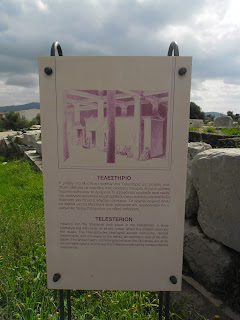
Third Pilgrimage : Eleusis


Sunday, February 24, 2013

The Birth, Life & Death of Alexander The Great


I know the title of this post sounds a bit cliche. Some weeks ago, i was reading Alexander`s biography in by Plutarch in his "Parallel Lives".  There are several  moments about Alexander the Great (Starting before his birth, during his life and death)  "Unknown" to most people who have not studied deeper the life of this great Hellenic warlord. So i thought it will be a good idea to put some of them here. I choose in my opinion the most intresting ones. There are much more. If you are intrested further, just check Plutarch.


BIRTH

"Well, then, the night before that on which the marriage was consummated, the bride dreamed that there was a peal of thunder and that a thunder-bolt fell upon her womb, and that thereby much fire was kindled, which broke into flames that travelled all about, and then was extinguished. At a later time, too, after the marriage, Philip dreamed that he was putting a seal upon his wife's womb; and the device of the seal, as he thought, was the figure of a lion"
 
AMONGST THE GODS
 
"However, after his vision, as we are told, Philip sent Chaeron of Megalopolis to Delphi, by whom an oracle was brought to him from Apollo, who bade him sacrifice to Ammon and hold that god in greatest reverence, but told him he was to lose that one of his eyes which he had applied to the chink in the door when he espied the god, in the form of a serpent, sharing the couch of his wife. Moreover, Olympias, as Eratosthenes says, when she sent Alexander forth upon his great expedition, told him, and him alone, the secret of his begetting, and bade him have purposes worthy of his birth. Others, on the contrary, say that she repudiated the idea, and said: "Alexander must cease slandering me to Hera."
 
 
VISIONS OF THE CONQUEROR

"He once entertained the envoys from the Persian king who came during Philip's absence, and associated with them freely. He won upon them by his friendliness, and by asking no childish or trivial questions, but by enquiring about the length of the roads and the character of the journey into the interior, about the king himself, what sort of a warrior he was, and what the prowess and might of the Persians. The envoys were therefore astonished and regarded the much-talked of ability of Philip as nothing compared with his son's eager disposition to do great things"
 
 
TEACHER AND STUDENT
 
"And now a general assembly of the Greeks was held at the Isthmus, where a vote was passed to make an expedition against Persia with Alexander, and he was proclaimed their leader. Thereupon many statesmen and philosophers came to him with their congratulations, and he expected that Diogenes of Sinope also, who was tarrying in Corinth, would do likewise. But since that philosopher took not the slightest notice of Alexander, and continued to enjoy his leisure in the suburb Craneion, Alexander went in person to see him; and he found him lying in the sun. Diogenes raised himself up a little when he saw so many persons coming towards him, and fixed his eyes upon Alexander. And when that monarch addressed him with greetings, and asked if he wanted anything, "Yes," said Diogenes, "stand a little out of my sun." It is said that Alexander was so struck by this, and admired so much the haughtiness and grandeur of the man who had nothing but scorn for him, that he said to his followers, who were laughing and jesting about the philosopher as they went away, "But verily, if I were not Alexander, I would be Diogenes."
 
SON OF THE GODS
 
"And now, wishing to consult the god concerning the expedition against Asia, he went to Delphi; and since he chanced to come on one of the inauspicious days, when it is not lawful to deliver oracles, in the first place he sent a summons to the prophetess. And when she refused to perform her office and cited the law in her excuse, he went up himself and tried to drag her to the temple, whereupon, as if overcome by his ardour, she said: "Thou art invincible, my son!" On hearing this, Alexander said he desired no further prophecy, but had from her the oracle which he wanted."
 
 
THE ENEMIES AND THE DOCTOR
 
"Dareius was still more encouraged by Alexander's long delay in Cilicia, which he attributed to cowardice. The delay was due, however, to a sickness, which assailed him in consequence of fatigues, according to some,but according to others, because he took a bath in the river Cydnus, whose waters were icy cold. Be that as it may, none of the other physicians had the courage to administer remedies, but thinking that the danger was too great to be overcome by any remedy whatever, they were afraid of the charges which would be made against them by the Macedonians in consequence of their failure; but Philip the Acarnanian, who saw that the king was in an evil plight, put confidence in his friendship, and thinking it a shameful thing not to share his peril by exhausting the resources of art in trying to help him even at great risk, prepared a medicine and persuaded him to drink it boldly, if he was anxious to regain his strength for the war. Meanwhile, however, Parmenio sent a letter to Alexander from the camp, urging him to be on his guard against Philip, for the reason that he had been persuaded by Dareius, with the promise of large gifts and a marriage with his daughter, to kill Alexander. Alexander read the letter and placed it under his pillow, without showing it to any one of his friends. When the time appointed was at hand, and Philip came in with the king's companions, carrying the medicine in a cup, Alexander handed him the letter, while he himself took the medicine from him with readiness and no sign of suspicion. It was an amazing sight, then, and one worthy of the stage, — the one reading the letter, the other drinking the medicine, and then both together turning their eyes upon one another, but not with the same expression; for Alexander, by his glad and open countenance, showed his good will towards Philip and his trust in him"

           MILITARY LIFE

"For in the stress of affairs he was not to be detained, as other commanders were, either by wine, or sleep, or any sport, or amour, or spectacle. This is proved by his life, which, though altogether brief, he filled to overflowing with the greatest exploits. In his times of leisure, however, after rising and sacrificing to the gods, he immediately took breakfast sitting; then, he would spend the day in hunting, or administering justice, or arranging his military affairs, or reading. If he were making a march which was not very urgent, he would practise, as he went along, either archery or mounting and dismounting from a chariot that was under way. Often, too, for diversion, he would hunt foxes or birds, as may be gathered from his journals. After he had taken quarters for the night, and while he was enjoying bath or anointing, he would enquire of his chief cooks and bakers whether the arrangements for his supper were duly made. When it was late and already dark, he would begin his supper, reclining on a couch, and marvellous was his care and circumspection at table, in order that everything might be served impartially and without stint;"

REMEMBERING THE ALTAR FIRE

"Moreover, as he was dispatching great quantities of the spoils home to Olympias and Cleopatra and his friends, he sent also to Leonidas his tutor five hundred talents' weight of frankincense and a hundred of myrrh, in remembrance of the hope which that teacher had inspired his boyhood. It would seem, namely, that Leonidas, as Alexander was one day sacrificing and taking incense with both hands to throw upon the altar-fire, said to him:— "Alexander, when thou hast conquered the spice-bearing regions thou canst be thus lavish with thine incense; now, however, use sparingly what thou hast." Accordingly, Alexander now wrote him: "I have sent thee myrrh and frankincense in abundance, that thou mayest stop dealing parsimoniously with the gods."


KING`S ARMOUR AND HORSE

"After sending this message to Parmenio, he put on his helmet, but the rest of his armour he had on as he came from his tent, namely, a vest of Sicilian make girt about him, and over this a breastplate of two-ply linen from the spoils taken at Issus. His helmet was of iron, but gleamed like polished silver, a work of Theophilus; and there was fitted to this a gorget, likewise of iron, set with precious stones.  He had a sword, too, of astonishing temper and lightness, a gift from the king of the Citieans, and he had trained himself to use a sword for the most part in his battles. He wore a belt also, which was too elaborate for the rest of his armour; for it was a work of Helicon the ancient, and a mark of honour from the city of Rhodes, which had given it to him; this also he was wont to wear in his battles. As long, then, as he was riding about and marshalling some part of his phalanx, or exhorting or instructing or reviewing his men, he spared Bucephalas, who was now past his prime, and used another horse; but whenever he was going into action, Bucephalas would be led up, and he would mount him and at once begin the attack."


THE GREATNESS OF A TRUE KING
                                                                   
"Again, a common Macedonian was driving a mule laden with some of the royal gold, and when the beast gave out, took the load on his own shoulders and tried to carry it. The king, then, seeing the man in great distress and learning the facts of the case, said, as the man was about to lay his burden down, "Don't give out, but finish your journey by taking this load to your own tent." Furthermore, he was generally more displeased with those who would not take his gifts than with those who asked for them. And so he wrote to Phocion in a letter that he would not treat him as a friend in future if he rejected his favours. Again, to Serapion, one of the youths who played at ball with him, he used to give nothing because he asked for nothing. Accordingly, whenever Serapion had the ball, he would throw it to others, until the king said: "Won't you give it to me?" "No," said Serapion, "because you don't ask for it," whereat the king burst out laughing and made him many presents."


THE DAY OF DEATH

"During this day, too, Python and Seleucus were sent to the temple of Serapis to enquire whether they should bring Alexander thither; and the god gave answer that they should leave him where he was. And on the twenty-eighth,towards evening, he died."