Sunday, February 14, 2021

Tip for the St Valentine's Day - The Origins of a Slogan

- Make War Not Love -

In the photo:
Marine Cpl. Michael Wynn in Da Nang (South Vietnam) portrays a proper version of the (back then) famous hippie slogan "make war not love"

 Film still taken from 1968 documentary In the Year of the Pig.

-

 The Origins of "Make Love Not War" slogan

Originally invented by the Hungarian-Jewish writter Gershon Legman and the Homosexual rights activist Rod McKuen. Soon the slogan adopted by the hippie peace movement of the 60s in their anti-war (see pro-communist) rallies.

Other than that, the slogan is used also by John Lennon, Bob Marley and Queen.

-

Knowing all these, OMAIMON PARADOSIS Hails Michael Wynn because he gave the proper answer in a perfect way, time and place!

SEE ALSO:
Long Live The Helter Skelter - Death To Pigs!


Wednesday, February 10, 2021

The Battle on The Ice

"Peregrinus, expectavi, pedes meos in cymbalis est!
 Vincant arma crucifera! Hostis pereat!"


After the frozen wastes of the coming scene of battle pointedly evoked by strings, a tramping motion in lower strings and brass depicts approaching Teutonic hordes. The Lating chanting returns, as do a number of motifs heard earlier in the cantata, as in the original film-score. Brass fanfares from the preceding movement mark the Russian counter-attack, and a scherzo-like section, skilfully amalgamated from disparate fragments of the film-score, the mounting excitement of the battle. A pile-driving march episode depicts the Russian victory and terrible loss of life, with a closing allusion to the Nevsky Song as calm descends on the carnage.

Richard Whitehouse


Saturday, February 6, 2021

Robert Brasillach - In Memoriam

ROBERT BRASILLACH
31 March 1909 - 6 February 1945

"The Past was so beautiful in short, that we must not blame fate"

 Brasillach saw himself as an intellectual rebel who might further through revolution the victory of the individual — conceived as a unique, creative, feeling animal — over the insensitive, unimaginative, manipulative plebs who threatened to engulf Europe with their mediocrity and their material aspirations in the name of progress and modernization. . .

Brasillach placed his hopes in the rebellion of those under thirty; and he dwelt at length on the virtues of joy and irony bringing about the birth of a post-liberal era. He insisted on the importance of an aesthetic view, rejected both Western corporate capitalism and Soviet bureaucratization, and deplored the rule of commodities over man.


William R. Tucker  - The Fascist Ego: A Political Biography of Robert Brasillach (1975)

More about Robert Brasillach HERE

Monday, February 1, 2021

The Superior Negotiation Skills of Vlad Tepes


Watching how the last decades how EU and especially the "Greek" goverment going to "peace talks" (see asslicking) with Turks, oftenly came to my mind how strong rulers of the past reacted to rapant turkish hunger for more european territory. Vlad Tepes knew very well how to treat this old enemy of Europe and the whole Europe must thank him for his ways.

There very little change of Turks since the times of Vlad Tepes but unfortunately Europe changed a lot...


("Vlad the Impaler and The Turkish envoys" by Theodor Aman)

 "... Turkish messengers came to [Vlad] to pay respects, but refused to take off their turbans, according to their ancient custom, whereupon he strengthened their custom by nailing their turbans to their heads with three spikes, so that they could not take them off."

 Antonio Bonfini - Historia Pannonica


( The Battle with Torches - 17 June 1462 by Theodor Aman)

 
"I have killed peasants men and women, old and young, who lived at Oblucitza and Novoselo, where the Danube flows into the sea, up to Rahova, which is located near Chilia, from the lower Danube up to such places as Samovit and Ghighen. We killed 23,884 Turks without counting those whom we burned in homes or the Turks whose heads were cut by our soldiers...Thus, your highness, you must know that I have broken the peace with him(Sultan Mehmet II)"

Vlad Tepes letter to Corvinus  - 11 February 462


Wednesday, January 27, 2021

An Artist of The Frontline - The Works of Hans Liska

 HANS LISKA (1907 - 1983)

Austrian-born Hans Liska is one of the most well-known and prolific WWII Axis illustrators, who served with the German Armed Forces (Whermacht) during the war from 1940 to 1944.

In 1942 and 1943 German publishing house Carl Werner in Reichenbach, sponsored by Junkers Flugzeug und Motorenwerke AG, published 2 albums with Hans Liska's sketches and color illustrations "to please the frontline soldiers and the workers of the weapon factories" in Germany.

Liska convincingly demonstrates that he has an eye for the real war drama, with all its pain, suffering, desperation, hard work, endurance, sense of duty, and courage for yet one more push to the utmost, which all participants are likely to share, no matter under what colors they fought and died.

-

Here are some photos of Liska in duty and also some of his scetches. 

More info, works etc about Hans Liska you`ll find at the end of this post.

At the frontline at Leningrad, October 1942


Info, photos and scetches taken from official Hans Liska website:
There you`ll find more about his life and several other of his works


Friday, January 22, 2021

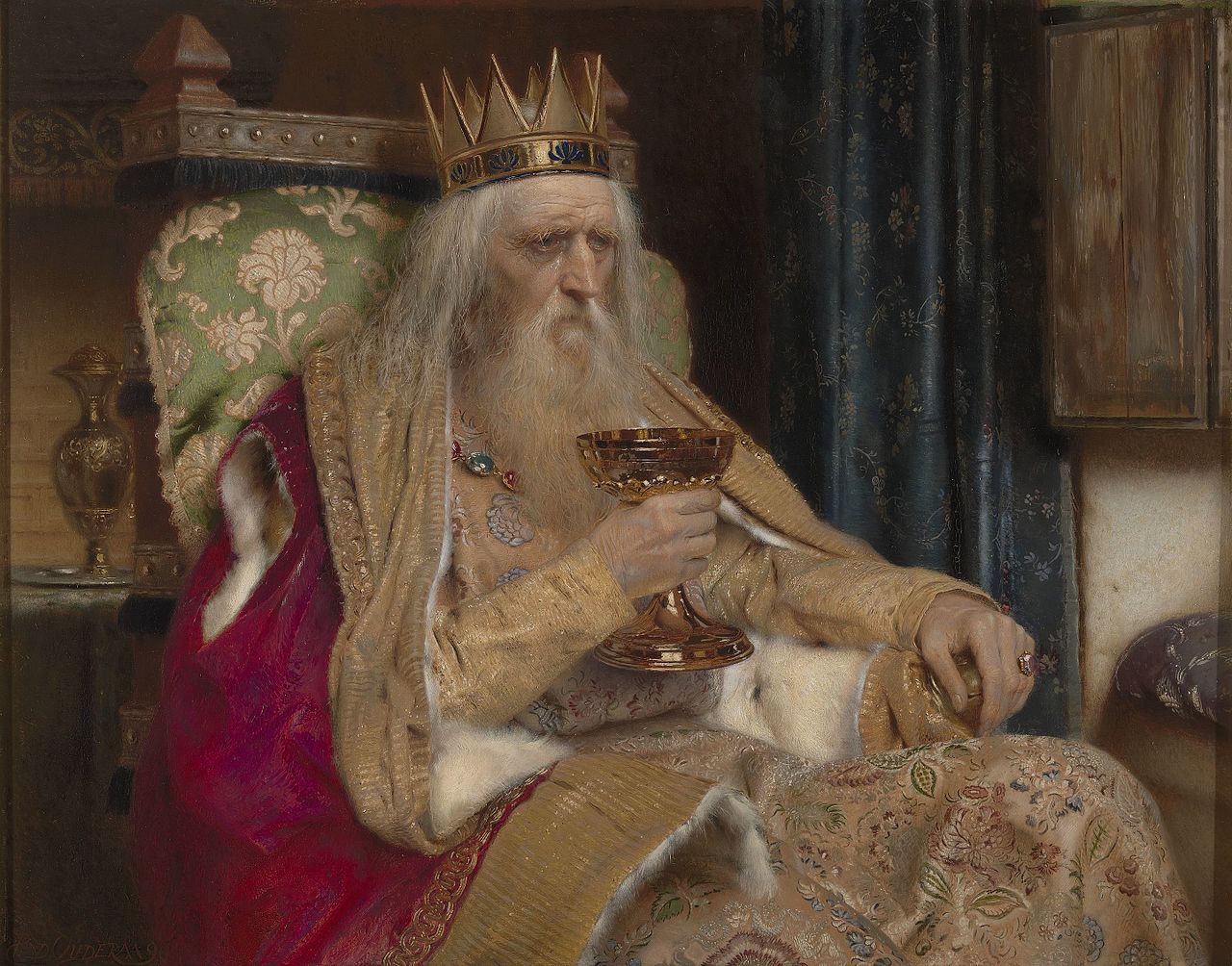
The King in Thule - The Painting, The Poem and a Song

- The Painting -

- The Poem -

There was a king in Thule,
Was faithful till the grave,
To whom his mistress, dying,
A golden goblet gave.

Nought was to him more precious;
He drained it at every bout;
His eyes with tears ran over,
As oft as he drank thereout.

When came his time of dying,
The towns in his land he told,
Nought else to his heir denying
Except the goblet of gold.

He sat at the royal banquet
With his knights of high degree,
In the lofty hall of his fathers
In the castle by the sea.

There stood the old carouser,
And drank the last life-glow;
And hurled the hallowed goblet
Into the tide below.

He saw it plunging and filling,
And sinking deep in the sea:
Then fell his eyelids for ever,
And never more drank he!


 ...and a Song -


THE PAINTING:
Pierre Jean Van der Ouderaa - The King of Thule (1896)

THE POEM:
Johann Wolfgang von Goethe - Der König in Thule (1774)

THE SONG:
Taken from film FAUST (1960)

-

 SEE ALSO:

Sturm und Drang

Faust's Arcadian Elegy

Tuesday, January 19, 2021

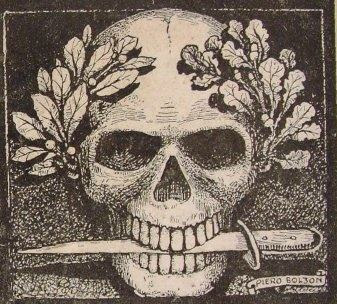
The Italian Cantos of Ezra Pound - Faith, Heroism and Deathskull's Return!


 "...A skull lies bleaching in the desert sand
& SINGS
Tireless, strident, sings, & sings, & sings:
– Alamein! Alamein!
We shall return!
We shall return!"


By the end of the year [1944] he had written Cantos 72 and 73 in Italian ... Full of vigor and images, exalting his old friends ... Marinetti, the founder of the Futurist movement, who, true to himself and his “interventism,” had gone to fight in Russia. And Admiral Ubaldo degli Uberti, whose phrase chi muore oggi fa un affare – untranslatable: dying today is a good bet – sums up the state of mind of the loyal Italians as defeat inevitably approached. Idealism and heroism were by no means all on the side of the partisans. [Pound] was infected by a desperate fighting spirit and faith. It is hard these days to define that faith or that spirit; it no longer seems a component of the air one breathe

Mary de Rachewiltz - Discretions (1971) 


 "...Where the skull sings our soldiers
Will return, those banners will come in."

SEE ALSO:

Ezra Pound (1885 - 1972) 

The Rider From a Dream

 Aesthetics of War