Sunday, April 25, 2021

A Prophetic Dream From An Esoteric Visionary


Here is the description of a dream from Miguel Serrano, the Chilean Esoteric visionary. According to the European traditions, oftenly the dreams are messages directly from the Gods, and whats best proof that Serrano's dream was just a glimpse of a bleak and dark future as this dream took place back in 1960's and it shows perfectly the world we live today.


THAT NIGHT IN ZURICH I had a dream. I saw a large white building several storeys high which looked like a university. It was full of students, most of them were studying the exact or applied sciences, engineering or physics. They all seemed to be sing their knowledge to achive tangible results; they were appplying it automatically without a thought to the significance of what they were doing They were untroubled by doubt and had no concern for vital essences. This university of my dream seemed to represent the world of the future. Themen coming out of the class-rooms were hald and metallic, expressing themselves only in the laws of mechanics, and were themselves becoming products of those laws. The last exponents of a world of flesh and blood had departed and, with their concern for a living earth with gods and demons, were considered by this new generation of anti-men as romantic idealists, the product merely of a decayed bourgeois society. Thus my dream seemed to suggest that the archetype of the future-or indeed of the present since that future has already arrived-would be the man of the atom and the machine, preparing himself for the conquest of space in a University building made entirely of concecrete and surrounded by asphalt.
 

In such a world I would be a total alien, unable to find a single niche from myself. Bu then I realized that people like Hesse and Jung had faced similar difficulties. They had now departed and were now untouched by the mechaniation of the earth and they had achieved other worlds which they had earned through realizing their own beings. I had little time left, but I knew that I myself would now have to make a similar effort so that I would never again return to this earth, but would step to another sphere. This I had to do if I was to save myself from the leaden desert into which the world was being transformed by machines. To escape from that horrible prison, I had to move along the same solitary path that had been followed by my older comrades, those wise men of flesh and blood who were the keepers of my dreams.

Miguel Serrano

Taken from the book "C.G.JUNG AND HERMAN HESSE -  A Record of Two Friendships" 1966


SEE ALSO:

The Miguel Serrano Website


Tuesday, April 20, 2021

For The Man of The 20th of April


To die thus,
As once I saw him die —
The friend who threw divine thunderbolts and
Glances into my dark youth.
Sportive and profound,
A dancer in the battle —

The most cheerful among warriors,
The gravest among victors,
A fate standing upon his fate,
Hard, reflective, calculating:

Trembling because he triumphed,
Rejoicing in that he triumphed dying:
Commanding while he died —
And he commanded that one destroy ...

To die thus,
As once I saw him die —
Vanquishing, destroying...

Friedrich Nietzsche - The Last Will


Sunday, April 18, 2021

The Roots and Authentic Meaning of Trolls in Folklore


A "troll" is actually not "an ugly & evil giant" in folklore. A troll is a wight that you can summon that you can summon or control via chanting. Ghosts, shadows, wraiths, living-dead, etc, are examples of trolls.
The "ugly & evil giant" of European folklore is the ettin. But that is a metaphor...


Troll translates as "(sorcerous) song" or even "spell". Sorcery in Norwegian is still called "Trolldom".

A "spell" is called "fortryllelse". To perform sorcery is "trylle".

Trylle = "to troll"

Ettin translates as "hungry" or "big eater"

"Magic wand" in english

"Troll rod/trolling rod" in Swedish (Trollspö)
Legitimate direct translation of "sorcery" or "magic" from Swedish: Trolling

Source :  Mythic Fantasy Role-playing Game (MYFAROG) Twitter


 SEE ALSO:

 The Nordic Origins of Tolkien's Balrog

Sunday, April 11, 2021

Echoes of Romanticism , The Greek National Anthem by The Pen of Rudyard Kipling

The Hellenic National Anthem originally written as "Hymn to Liberty" by the Romantic poet Dionisios Solomos in 1823. In 1865, from its 158 stanzas,  two of it officially adopted by the Hellenic state as the official anthem of Greeks. 
For those who had read the full poem, the "Hymn to Liberty" is a momument of Romanticism inspired by Hellenic wars of independence against the Turks. It is there that Dionisios Solomos captured the true soul and character of the Hellenic Nation through out the centuries.

In 1918, almost a century later, the English giant of poetry Rudyard Kipling translated of part of Hymn To Liberty in English.
This excellent translation of transfering into the english language follows below.
Only a real master and talent such as Rudyard Kipling can do such a splendid work.


 The Greek National Anthem

 by

 Rudyard Kipling


 WE knew thee of old,    
  Oh divinely restored,    
By the light of thine eyes    
  And the light of thy Sword.    
 
From the graves of our slain            
  Shall thy valour prevail    
As we greet thee again—    
  Hail, Liberty! Hail!    
 
Long time didst thou dwell    
  Mid the peoples that mourn,            
Awaiting some voice    
  That should bid thee return.    
 
Ah, slow broke that day    
  And no man dared call,    
For the shadow of tyranny            
  Lay over all:    
 
And we saw thee sad-eyed,    
  The tears on thy cheeks    
While thy raiment was dyed    
  In the blood of the Greeks.            
 
Yet, behold now thy sons    
  With impetuous breath    
Go forth to the fight    
  Seeking Freedom or Death.    
 
From the graves of our slain            
  Shall thy valour prevail    
As we greet thee again    
  Hail, Liberty! Hail!


 SEE ALSO:
The Forbidden Poems of Rudyard Kipling


Monday, April 5, 2021

EZRA POUND: American Odyssey


"The controversial American poet Ezra Pound is the focus of this standard biographical documentary by Lawrence Pitkethly. Pound's life is passed in review, from his childhood in the U.S. to his adult career in Europe where he becomes friends with other well-known writers such as James Joyce, Ernest Hemingway, and T.S. Eliot. One of the controversies about him raged around his defense of Italian fascists and his anti-American stance in World War II, a position that got him imprisoned after the war. Interviews with his acquaintances and scholars who have researched his poetry and life illuminate the documentary, but not as hauntingly as the poetry itself, in some instances recited by Pound in his later years. Historical footage of the poet also adds to the vision of his life."

SEE ALSO:

Ezra Pound (1885-1972)
The Italian Cantos of Ezra Pound - Faith, Heroism and Deathskull's Return!


Sunday, March 28, 2021

Julius Caesar, Nietzsche, Machiavelli and The Role That Binds Them


Ciaran Hinds, the ultra talented Irish actor speaks of how he approached his role as "Julius Caesar" in the excellent HBO series ROME


AVC: How do you approach a character like Caesar, who had such a mythic presence, and yet was, in the end, just a man?

"Nietzschean. The superman. Fucking ridiculous. I'm pre-Christian, and all the rules and all the morals, they're not in play. The only thing that I can really relate to is the subterfuge of politics, which will be with us always. That I understood, the Machiavellian nature of "You say one thing, but you buy them off with another." A great theory is "Listen, don't kill people. Make them your friends. It's easier." Then you take their friends along with them. But if they really give you shit, then you fuck everybody up. That's the idea. If you start to run, you're in power, make sure you cover everybody."

 Ciaran Hinds interview at AVCLUB.COM , 1/42010

 SEE ALSO:
ROMA CAPUT MUNDI

Friedrich Nietzsche on Freedom

Monday, March 22, 2021

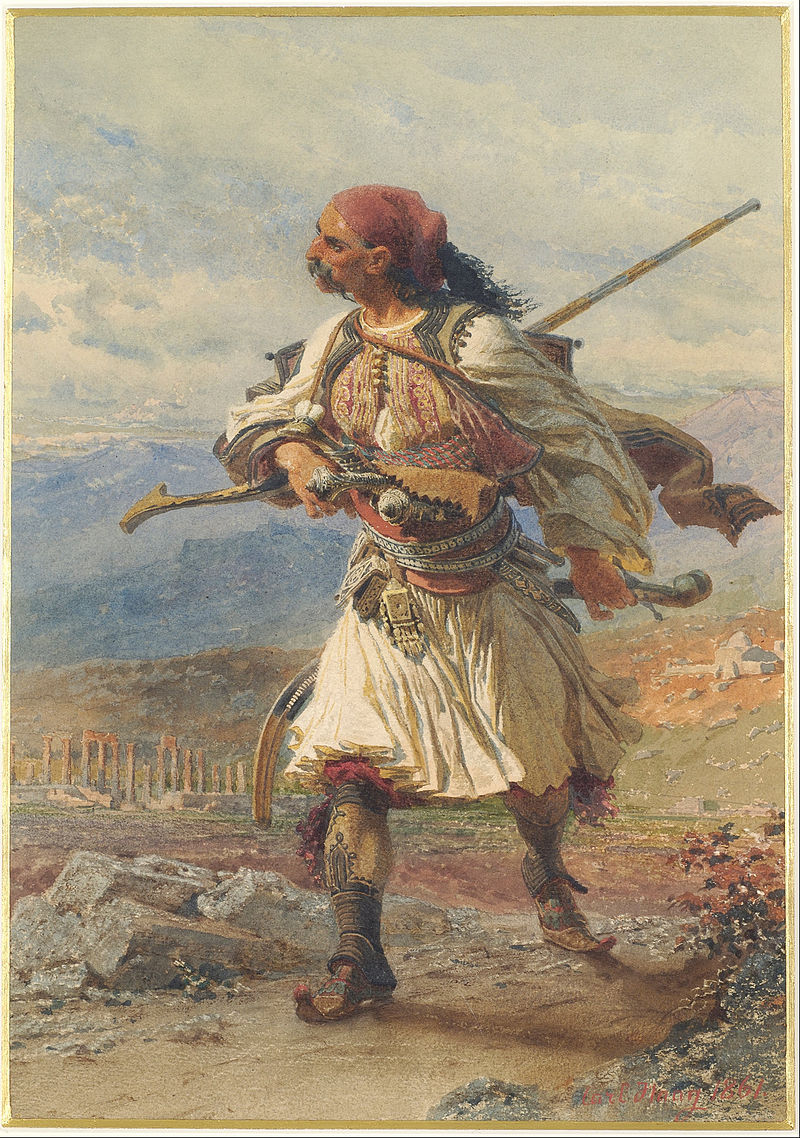
The Armed Greek Mountain Outlaws and Their Songs

The Outlaws of The Greek Mountains and their songs

"Klephts : Greek κλέφτης, kléftis, pl. κλέφτες, kléftes, which means "thief" and perhaps originally meant just "brigand"were highwaymen turned self-appointed armatoloi, anti-Ottoman insurgents, and warlike mountain-folk who lived in the countryside when Greece was a part of the Ottoman Empire They were the descendants of Greeks who retreated into the mountains during the 15th century in order to avoid Ottoman rule. They carried on a continuous war against Ottoman rule and remained active as brigands until the 19th century. " Taken from Wikipedia - Full Article here

Oftenly these Greek outlaws had their own songs. Songs about Heroism, Death in battle, courage, attack on enemies etc And also sometimes about their way of life in Mountains and villages.

Below are some fragments from some of their songs

taken by the book:

 THE SONGS OF GREECE
by
By Charles Brinsley Sheridan , Published in March 1825

The pics in-between are portaits of the classic type of these outlaws


 "'Tis DEATH! - erect my tomb - but broad and high!
That when I hear the Moslems'battle-cry,
I may have space to raise my mould'ring corpse;
Appal with death, strike with living force!"


Taken from THE TOMB OF THE KLEPHT


"The Moslems counted thrice -
Five hundred Turks were slain-
The Klephtai count, and lo!
They all but three remain;

And one is gone for bread
and one is gone for water,
And one lies cold and dead;-
But one the foe could slaughter."


Taken from BOUKOVALLA


"That bloody flag is down,
That turban'd host are slaves
HELLAS HAS SMOTE THE TURK
UPON HER NATIVE WAVES"


Taken from STATHAS


"A summer storm more desolate
Than wintry wihrlwinds drives;
While with the turban'd foes of Greece
Kontoghianni strives"


Taken from KONTOGHIANNI


"THIS summer came the Pasha's threat;
Its seal was hot, its ink was wet:
"Ye Klephts, who hold each mountain height,
Descend and bow to Ali`s might"
But two, the boldest sons of Greece,
Will never pay that price for peace;
These grasp their guns and glittering swords,
And seek what cheer the wild affords"


Taken from THE SUMMONS TO THE KLEPHTAI OF MOUNT OLYMPUS


"The brave have here a citadel
In every lonely glen;
Rather than share with Turks the mosque,
We share with beasts the den"


Taken from STERGHIOS


"Fearless and few the Grecians met
Before the dawn of day;
To Pravi's brdge, with morn's foirst beams,
The forced their desperate way.

Then Tzaras, with damask blade,
Cut through the opposing chain;
And all the Turks, like timid kids,
Were scatter'd o`er the plain."


Taken from NIKO-TZARAS AT THE BRIDGE OF PRAVI