Monday, December 5, 2022

Samhain in Helvetia


This year I had the chance to spend some days in Switzerland. In the rural area of the German-speaking Canton of St. Gallen. Honestly speaking, it was the ideal place to spend before, during and after the Samhain. Walking around lake Constance, visiting castles, medieval libraries and gothic cathedrals, accompanied with fog, rain and also some sunshine (I was told that this was a very rare phenomenon for this time of the year). But from all the places I visited, the one that impressed me most was the Carl G. Jung House which is located in the lake Zurich. 

Some years ago I`ve got in my hands Miguel Serrano's book "C.G. Jung and Herman Hesse: A record of two friendships". It was from there that I was really impressed by the personality of Carl Gustav Jung and also from his way of living and his surroundings. Ofcourse I was already aware of his excellent essay WOTAN ( there he explains and analyze the National Socialist phenomenon), but it was through Serrano's book that I understood that Jung was not just another famous psychologist as oftently portrayed in the mainstream press, but also other things further than that. A mysticist and an artist.

Thats why in this thread from all the days, places and several photos I took,  I think it deserve a post of photos dedicated only to my visit in Jung Haus and also from the cemetary that his grave is located. Unfortunately, in the house it was forbidden to take any pics inside. So here I post photos from all around the house. But here I put the descriptions that Miguel Serrano gave from the house when he was met with Jung during the 1950's.  Believe me,  things inside, even after so many decades later,  is EXACTLY the same as Serrano described it. I showed this to a member of the house stuff that guiding us inside and she was really impressed of how truly accurate this descriptions are. 

Two intresting notes. The library of Doctor Jung is perhaps the most brilliant private library I have ever seen. Full of medieval or very old historical, mythological, mystical/magical and alchemical books. Most of them leather-bound,  placed in wooden shelves that goes up to the top of the room and you need a moving stair to see them. Also in a room I was find it suprizing that he had a bust of Homer and also the only pic of him was when he visited Acropolis Athens placed in a chair (I managed to take a pic of this from outside).

Ok, so here we go with the photos of both the house and the grave. All text taken from Miguel Serrano's above mentioned book.

Küsnacht/Lake Zurich  - THE HOUSE BY THE LAKE


"....I left immediately and arrived in time at his house in Küsnacht. Over the doorway of his house was written an inscription in Latin: Vocatus adque non vocatus, Deus aderit. [Called or not called, God is present.] "


"The inside of the house seemed dark and shadowy. I was greeted by the same woman I had seen with Jung in Locarno, and she introduced herself as Miss Bailey. She asked me to go up, and as I climbed the stairs, I noticed that the walls were covered with ancient drawings of medieval and Renaissance scenes."


"I then waited in a little room upstairs. In due course, Dr. Jung appeared and greeted me cordially, asking me to go into his study, which had a window overlooking the lake. In the center of the room was a desk covered with papers, and round about were many bookcases. I noticed some bronze Buddhas and over his work table a large scroll showing Siva on top of Mount Kailas. That painting forcibly reminded me of the many pilgrimages which I myself had taken into the Himalayas. We sat down beside the window, and Dr. Jung made himself comfortable in a large armchair opposite me."


"It was late when I left Jung’s house, and as I walked down towards the lake, I thought of our conversation and tried to put my feelings in order."


THE CEMETARY - A RESTING PLACE OF A MYSTICIST


"The Jung family tomb is at Kusnacht and we went there to visit it.  Standing on the gound is large round stone with  a cavity in the centre which catches rainwater. Nearby is another vertical stone engraved with the family crest.  The base of this stone is squared, and on each side is latin inscription: "First the terrestrial man of the earth, Second "The Celestial man of heaven". I believe these are taken from the writting of St Paul.  The part of the inscription is ofcourse the same as is found on the gate of Jung's House"


Wednesday, November 30, 2022

Tuesday, November 15, 2022

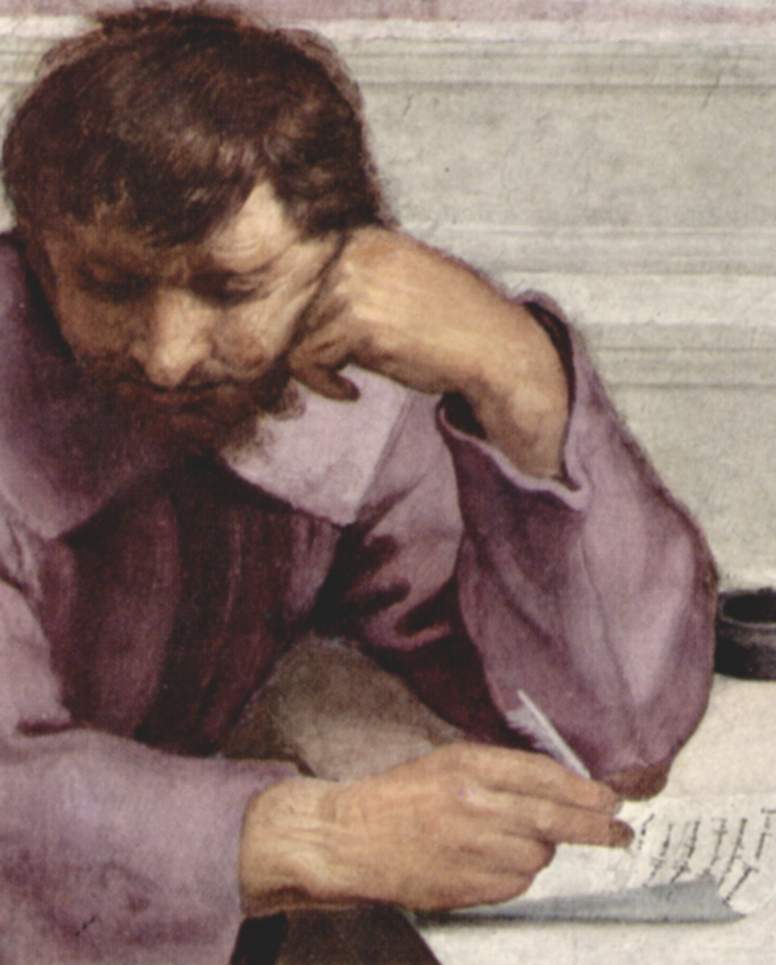
The School of Athens - A Renaissance View of The Creators of Western Civilization


THE SCHOOL OF ATHENS

By 

The Cultural Tutor


The School of Athens, created by Raphael in 1511, is one of the world's most famous paintings.


But who are all these people in it?

1) Heraclitus (535-475 BC) Pre-Socratic philosopher whose work only survives as "Fragments." These have long given him an aura of mysterious wisdom. Here portrayed as Michelangelo (1475-1564) Italian Renaissance painter, sculptor, and architect, best known for his statue of David.


2)Euclid (4th-3rd century BC) The founder of geometry. His work "The Elements" was a standard maths textbook for over 2,000 years. Portrayed as Bramante (1444-1515) Italian architect who brought the Renaissance style to Rome and Milan. He helped design St. Peter's Basilica.


3)Anaximander (610-546 BC) Important pre-Socratic philosopher from Miletus. The first philosopher known to have written down his studies, he was also an early scientific thinker whose ideas influenced geometry, geography, and astronomy.


4)Left: Aeschines (389–314 BC) Athenian soldier, statesmen, and orator. Listed in the Alexandrian Canon as one of the 10 Attic Orators - the greatest speakers of classical Athens.

Right: Socrates (470–399 BC) The godfather of Western philosophy.


5)Plato (424–347 BC) Second founder of Western philosophy. Student of Socrates, teacher of Aristotle. He started the Academy: the first higher educational institution in the West. Portrayed as Leonardo da Vinci (1452-1519) The ultimate Renaissance man.


6) Left: Pythagoras (570-495 BC) Incalculably important philosopher who contributed to mathematics, ethics, music, metaphysics, and more.

Right: Archimedes (287-212 BC) Inventor, engineer, physicist, astronomer, genuine genius, and the greatest ancient mathematician.


7) Diogenes (412-323 BC) Ultimate Cynic philosopher. He begged for a living, sabotaged Plato's lectures, and made fun of Alexander the Great (to his face). He lived in conscious protest against the perceived hypocracies, trivialities, and pretensions of his age.


8) Parmenides (6th-5th centuries BC) The founder of ontology, i.e. the branch of philosophy that considers existence and reality.


9) Left (with helmet): Alcibiades (450–404 BC) Controversial Athenian general, statesmen, democratic leader, and trouble-maker; both a hero and a villain, but a hero in the end.

Right (with hat): Antisthenes (446–366 BC) The founder of Cynic philosophy, pupil of Socrates.


10) Epicurus (446-366 BC) Philosopher and founder of Epicureanism, an alternative to Platonism. His teachings focussed on the way to achieve human contentment, though this has sometimes been misrepresented as a sort of materialistic hedonism.


11) Carneades (214–129 BC) A founder of Skepticism. He reacted against the dogmatic adherents of Stoicism and Epicureanism by questioning human ability to ascertain truth at all.


12) Aristotle (384–322 BC) Impossible to summarise other than by saying he has influenced every aspect of Western culture and philosophy.


13) Left: Raphael himself, here portraying Apelles, a 4th century BC Greek painter and the most celebrated master of Antquity.

Right: Perhaps Il Sodoma (1477-1549) an Italian Renaissance painter, here portraying Protogenes, a contemporary of Apelles.


15) Zeno of Citium (334-262 BC) The founder of Stoic philosophy.


SOURCE : https://threadreaderapp.com/user/culturaltutor


SEE ALSO:

THE MEDICI : Godfathers of The Renaissance

Wednesday, November 9, 2022

To The Dead of November 9th

You dead heroes

Never were you nearer to us —,

Reminder, call, prayer —

As now when the Grim Reaper

Stands before us.

Never were you so necessary to us.

Towers in the storm of care.

Never were you as alive to us.

We are as acquainted with you as we are with death.

We listen for the call. And we hear

In the night, when all is silent

Your voices. They warn, they swear:

Not only victories! The victory!

As our flags sink

God goes as the wind through the field.

All our thanks and thoughts

Become deed.


Gerhard Schumann


Saturday, November 5, 2022

To Ride The Solar Storms


These, plus more Spear of Longinus stuff are (and will be) available from:

https://www.black-metal-vendor.com/

Tuesday, November 1, 2022

The Dying Warrrior and The Fallen Comrades

 - IN MEMORIAM - 

1/11/2013

Georgios Fountoulis - Manolis Kapelonis

THE DYING WARRIOR

"The dying warrior on the east pediment (c. 480 BCE) marks a transition to the new Classical style. Although he bears a slight Archaic smile, this warrior actually reacts to his circumstances. Nearly every part of him appears to be dying. Instead of propping himself up on an arm, his body responds to the gravity pulling on his dying body, hanging from his shield and attempting to support himself with his other arm. He also attempts to hold himself up with his legs, but one leg has fallen over the pediment's edge and protrudes into the viewer's space. His muscles are contracted and limp, depending on which ones they are, and they seem to strain under the weight of the man as he dies."

Source : Sculpture in The Greek Archaic Period Blog